
699 view(s)
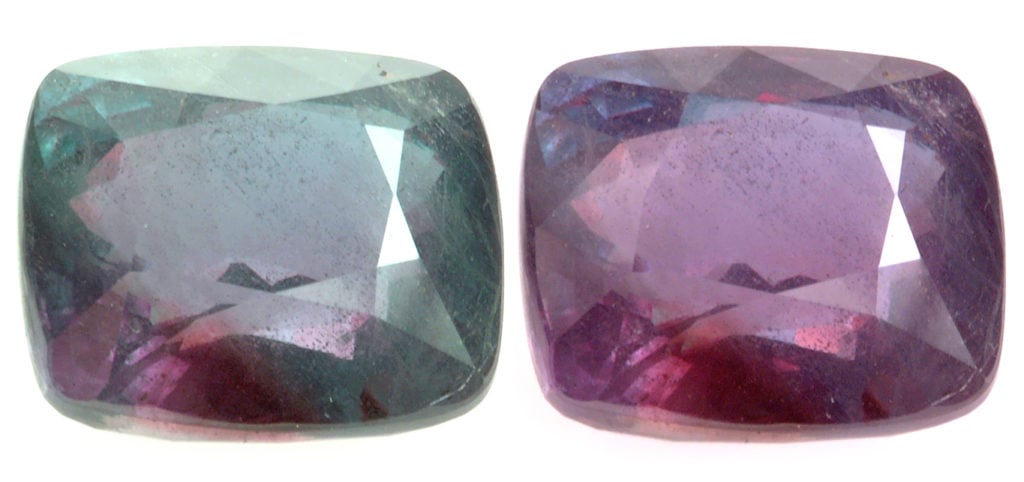 Step Cut Alexandrite Cushion, 26.75 carats. Photographed by David Weinberg for Alexandrite.net and released to the public domain.
Alexandrite, the birthstone for June, is a gorgeous color-change species of chrysoberyl. Found only in a handful of places around the world, this gorgeous stone remains very rare in the gemstone market. Furthermore, large specimens of alexandrite remain few and far between. For this reason, I have only two gems I can tell you about in detail.
Step Cut Alexandrite Cushion, 26.75 carats. Photographed by David Weinberg for Alexandrite.net and released to the public domain.
Alexandrite, the birthstone for June, is a gorgeous color-change species of chrysoberyl. Found only in a handful of places around the world, this gorgeous stone remains very rare in the gemstone market. Furthermore, large specimens of alexandrite remain few and far between. For this reason, I have only two gems I can tell you about in detail.
The Sauer Alexandrite
First of all, the Sauer Alexandrite was found in 1967, in the Jaqueto District of Bahia, Brazil. Not surprisingly, it was named after its discoverer, the founder of Lapidação Amsterdam Limitada (Amesterdam Jewelers Limited), Jules Roger Sauer. This incredible gemstone remains the largest uncut specimen of June's birthstone. It weighs an astonishing 122,400 carats (just shy of 54 pounds). Rather than cutting or selling the stone, Sauer decided to keep it as part of his private collection. For more than 50 years, Sauer not only created and sold gemstone jewelry, he also prospected for gemstones. Living in Ipanema, Rio de Janeiro, near the heart of Brazil's gemstone district, he amassed a large collection of fantastic gemstone specimens. In 1989, he decided to open a museum, affording the public an opportunity to enjoy his collection. The Sauer Museum has remained open since then. Sadly, in 2017, at the age of 95, Jules Sauer passed away. After that, the Sauer Alexandrite remained on display at the museum for quite some time. Unfortunately, it appears to have been removed from display. According to one museum visitor, staff members at the museum either know nothing of it, or they choose not to discuss it. (source) One possibility is that Sauer sold it to another private collector at some point.Kochubei's Druse
In 1840, in the Russian mine Izumrudnye Kopi, the largest cluster of alexandrite crystals found their way into the private mineral and gemstone collection of Count Lev Alekseevich Perovskii. Count Perovskii served as Minister of Internal Affairs of Tsar Nicholas I of Russia. He also bore a noble title and studied mineralogy. Evidently, in 1845, he proposed the establishment of Russia's first Geographical Society. Following the count's death in 1856, his friend and fellow mineralogist, Prince Petr Arkadievich Kochubei, acquired the crystal cluster to add to his private collection. Prince Kochubei worked tirelessly to better his community and country. His efforts led to the foundation of the Russian Technical Society. His interest in the technical pursuits of his fellow man, including photography, aeronautics, electrical engineering, and more, inspired him to establish a Technical Museum. In addition to collecting objects related to his interests, he also began collecting mineral specimens. He hosted weekly mineralogical meetings at his home, where men of renowned intellect came to "talk science." (source) In 1913, Prince Kochubei arranged the sale of his entire mineral collection, including the alexandrite crystal cluster, to the Russian Academy of Sciences. At the time, A.E. Fersman facilitated the acquisition by the Academy. Today, the A.E. Fersman Mineralogical Museum exhibits all 2,588 specimens from Kochubei's collection. This includes the crystal druse named after him, which consists of 22 dark green alexandrite crystal mixed in with mica scales and pale green beryl prisms. The specimen measures 25 x 14 x 11 cm.Other Museum-Quality Alexandrites
The largest cut alexandrite, weighing 65.7 carats, belongs to the Smithsonian Institute. The stone originated from a mine in Sri Lanka. Two more large Sri Lankan specimens reside at the British Museum of Natural History in London. One weighs 43 carats, the other weighs 27.5 carats. A cluster of three Russian crystals measuring 6 x 3 cm belongs to the Institute of Mines in St. Petersburg, Russia. Though notably smaller than those found in Sri Lanka and Brazil, Russian alexandrite is the cream of the crop. The largest specimens found in Russia weigh no more than 30 carats. For those found in other locales, some private collectors have reported specimens as large as 50 carats. Of course, these are not on public display. Also, I have been unable to verify these reports. If you hear of any other legendary alexandrite specimens, please drop us a line in the comments or find us on Facebook and let us know! ~Angela Magnotti Andrews2019-06-25 04:06:12
1138 view(s)