
692 view(s)
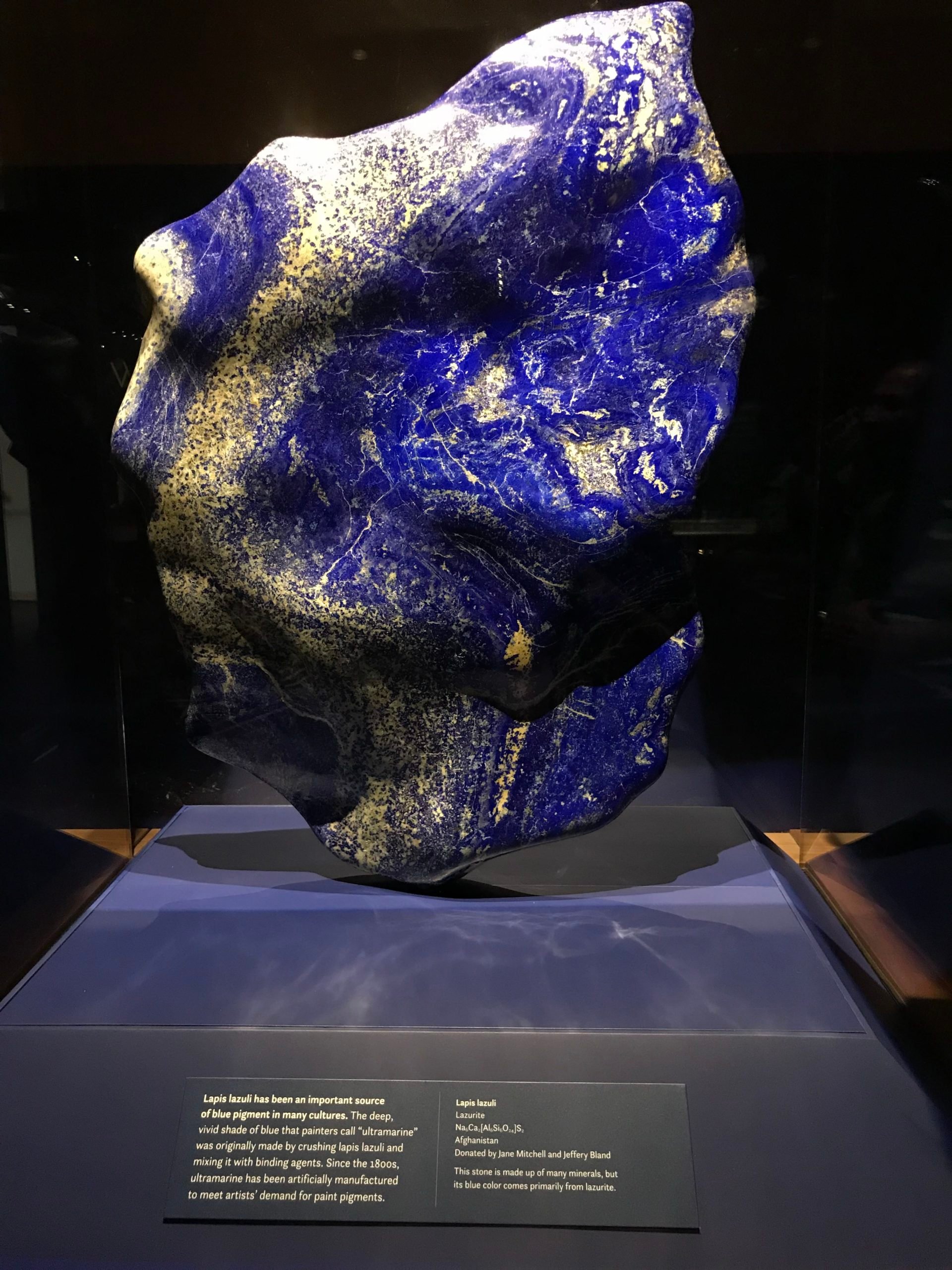 Lapis lazuli on display at Natural History Museum, Washington, D.C. (Wikimedia)
Lapis lazuli has long been prized for its uniquely vibrant blue color. The GIA describes the highest quality lapis as "slightly greenish blue to violetish blue" with a medium-to-dark tone and rich saturation. As with all stones, lapis owes its gorgeous coloring to its unique mineralogical properties.
Lapis lazuli on display at Natural History Museum, Washington, D.C. (Wikimedia)
Lapis lazuli has long been prized for its uniquely vibrant blue color. The GIA describes the highest quality lapis as "slightly greenish blue to violetish blue" with a medium-to-dark tone and rich saturation. As with all stones, lapis owes its gorgeous coloring to its unique mineralogical properties.
Mineralogical Description of Lapis Lazuli
To speak in mineralogical terms proves a bit of a misdirection. In fact, lapis is a rock, not a mineral. By definition, a rock is an aggregate (combination) of several different minerals which bond together. (source) However, in the case of lapis, mineralogists include it in their databases because of its cultural significance. Lapis forms as massive slabs of several silicate minerals mixed and layered together. As such, it belongs to the silicate class of rocks, in a subclass called tectosilicates. Due to its aggregate nature, it falls into two groups of minerals, feldspar and sodalite. (source) First discovered in the mountains of Afghanistan about 6,000 years ago, lapis lazuli has been used as a medium for sculpting, jewelry making, and pigment formulations for thousands of years. (source) Lapis Lazuli specimen. Wikimedia Commons.
Chemical Composition of Lapis Lazuli
Three primary minerals comprise lapis. First of all, lazurite, which accounts for between 25% and 40% of a specimen. Lazurite is a blue silicate mineral in the sodalite group. It contains a blend of sodium, calcium, silica, and aluminum, plus sulfur atoms. The color blue in lazurite occurs as a result of a transfer of electrons between the sulfur atoms. (source) Not surprisingly, lapis lazuli owes its blue coloring to the presence of this beautiful mineral. (source) Another significant component of lapis is white calcite, which actually serves as its host rock. As with many aggregates, lapis typically contains either streaks or bands of this white mineral. (source) The final visible mineral included in lapis is pyrite, or Fool's Gold. Other aggregate minerals in lapis, which are not distinguishable to the naked eye, include afghanite, augite, diopside, dolomite, hauynite, hornblende, mica, noselite, sodalite, and/or wallastonite. (source, source)
Signature Features
At a minimum, for mineralogists and gemologists to classify a specimen as lapis, it must feature the signature blue color, as well as at least 25% lazurite. Furthermore, in gem quality lapis, the white calcite must not dilute the color. It's all right for a specimen to have white streaks and even some banding. However, if these streaks overshadow the rich blue color, the value of the stone falls. (source) Sparkling bits of pyrite scattered evenly throughout provide a natural enhancement to the beautiful blue gem. (source) Sometimes the pyrite distributes in patches or clustered streaks. Other times, it acts as a filler for fractures, which can look very beautiful. (source) As long as the pyrite inclusions do not detract from the overall beauty of the stone, they will not degrade its value. Due to its aggregate nature, lapis often forms in large specimens. This allows jewelry designers tremendous latitude in fashioning large statement pieces out of this beautiful blue stone. Oftentimes, they craft ornate settings for the beautiful stone. As such, lapis lazuli proves an important consideration for anyone serious about collecting one-of-a-kind jewels. ~Angela Magnotti Andrews2020-10-25 00:08:28
948 view(s)