
699 view(s)
 Egyptian Blue Pigment (Wikimedia)
Egyptian blue was the first synthetic blue pigment ever created. To create this beautiful blue color, the Egyptians tried to use lapis lazuli. However, their attempts repeatedly ended in a murky gray color caused by intrusive calcium and limestone. Instead, they found other minerals to create this wondrous color.
Egyptian Blue Pigment (Wikimedia)
Egyptian blue was the first synthetic blue pigment ever created. To create this beautiful blue color, the Egyptians tried to use lapis lazuli. However, their attempts repeatedly ended in a murky gray color caused by intrusive calcium and limestone. Instead, they found other minerals to create this wondrous color.
What Makes Egyptian Blue So Special?
Historically, the color blue seems to be missing from most ancient cultural languages. Neither Romans nor Greeks created a word for the ethereal color. (source) The Japanese, Chinese, and Hebrew languages also failed to include words for the color blue. (source) In fact, the only ancient language featuring a word for the color blue is the Egyptian language. It stands to reason that Egyptians were the first to experiment with creating a blue pigment. Experts believe they drew inspiration from turquoise and lapis lazuli. Not surprisingly, they sought to recreate the color for use in their works of art. (source)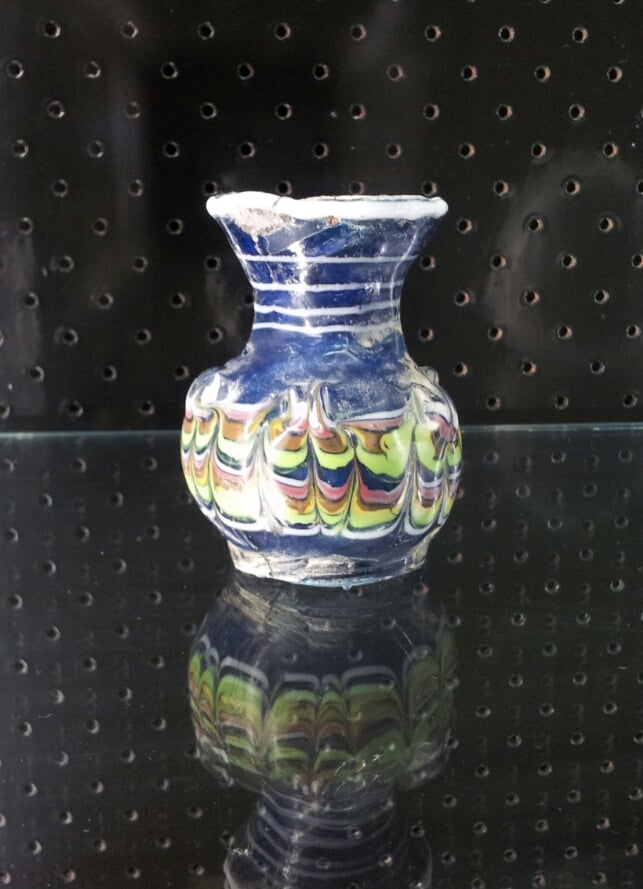 Egyptian Blue Glaze. Wikimedia Commons.
Creation & Composition of Egyptian Blue
As I mentioned before, the Egyptians tried to make pigment out of lapis. After all attempts failed, they combined several other minerals which resulted in success. Around 2,200 BC, these ancient master chemists crushed limestone, mixed it with sand, and added an assortment of copper-bearing minerals, either azurite or malachite. Next, they heated the mixture to temperatures ranging between 1470 and 1650 degrees F. (source) Then they finely crushed the resulting opaque blue glass and mixed into a thickening agent, such as egg whites, gum, or glue. (source) They used the blue glaze to decorate pottery, wood, stone, plaster, papyrus, and canvas. (source) Egyptian Blue glaze on ancient pottery. Wikimedia Commons.
Historic Use of Egyptian Blue Pigment
Of course, the Egyptians used copious amounts of this gorgeous blue dye. Many of their statues, pottery relics, and even tombs demonstrate how enamored they were this this color. With the bustling trade routes passing throughout the ancient lands, Egyptian Blue became popular in Rome and Greece, as well as in Persia and Mesoamerica. Not surprisingly, the pigment was very expensive. (source) As a result, the color belonged solely to royalty and their commissioned artists. Egyptian Blue remained one of the only blue coloring agents until the mid-300s BC. Artisans eventually created new formulations for more affordable blue pigments. In fact, the latest blue pigment was discovered by accident in the last decade. That being said, Egyptian Blue forever marks the beginning of the history of the color blue. ~Angela Magnotti Andrews2020-10-23 20:14:21
1847 view(s)