
684 view(s)
 Previously, you read about how Color and Clarity affect the price of blue sapphires. In this article, you will learn how Cut and Carat Weight, the final two of the 4Cs, affect the valuation of blue sapphires.
Cut
After Color and Clarity, the Cut of a blue sapphire plays the next crucial role in determining a particular stone's value. As with diamonds, cut plays the largest role in a sapphire's scintillation. It also influences the depth of visible color, as well as the size the stone appears to the eye. (source) When grading cut for a sapphire, gemologists take into account the symmetry of the facets, as well as any obvious windowing or extinction. Overall, the greater the brilliance and symmetry, the higher the value. Those who cut sapphires with an emphasis on size, rather than brilliance, literally fail to make the cut on close inspection. Such stones exhibit lopsided dimensions, as well as unpleasant dead spots (extinction) or light-leaking windowing. (source)Extinction in Blue Sapphires
Extinction refers to areas in the stone that appear black. These black spots remain no matter from which angle or direction you look at the stone, though they jump from one facet to another as the stone is tilted. (source) Extinction is present right from the beginning in certain pieces of sapphire rough. It proves more common in dark colored stones, though it occurs in light colored stones sometimes, as well. A skilled cutter can often orient the rough in such a way as to minimize the effect. However, there is no way to completely eliminate it without cutting the stone so shallow that it exhibits little to no brilliance. (source) To determine the amount of extinction in a faceted sapphire, a gemologist holds the loose, cut stone over a white background under natural daytime lighting conditions. She then determines what percentage of the visible surface of the stone reflects back the gem's true color. (source) Keep in mind that extinction does not refer to darker color zones within the stone. Only if the stone appears dead black in places is extinction at play.Windowing in Blue Sapphires
Windowing occurs when a sapphire is cut too shallow, allowing light to escape through one or more of the stone's facets instead of reflecting it back to the eye. Windows appear exactly as you would expect, as open spaces in the stone that allow you to look all the way through to the other side. As the experts at Gem Rock Auctions state, if you can read your book through your stone, then it has a window! (source) Both windowing and extinction drive the price of a blue sapphire down.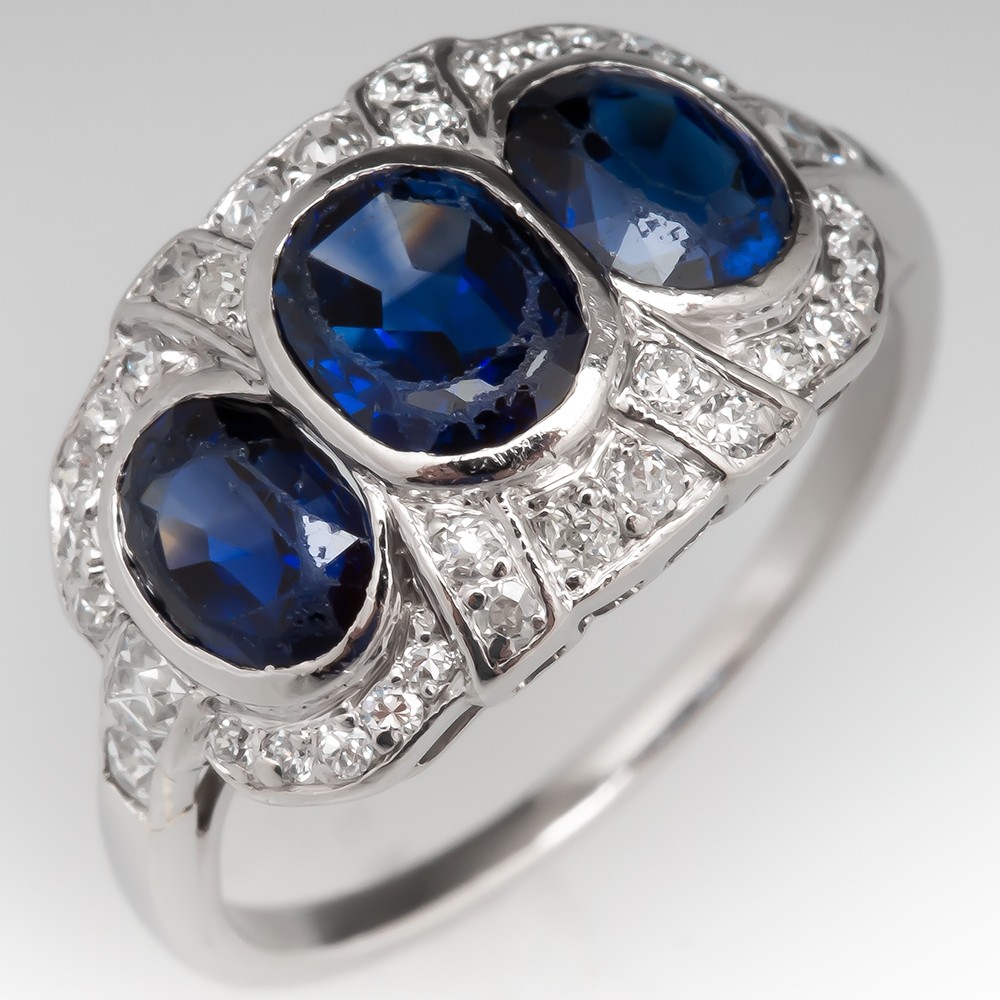
Carat Weight
The final of the 4Cs, and the fourth most important factor in determining the value of a blue sapphire, is Carat Weight. In fact, experts state that carat weight actually represents the fifth most important factor. According to GemFix, the face-up diameter of a sapphire proves more important than the precise carat weight. (source) The reason for this stems back to the relative density of sapphire compared to diamonds. Sapphires are denser than diamonds. As a result, a 1-carat diamond proves larger in diameter than a 1-carat sapphire. That being said, carat weight still affects price. Particularly for larger stones, since those larger than 5 carats prove extremely rare. After reading both articles, you are now armed with the basics of the 4Cs and how they affect the price of blue sapphires. Should you have any further questions, please don't hesitate to reach out and ask. ~Angela Magnotti Andrews2020-02-23 18:43:42
351 view(s)